
What Is a SIP Intercom System?
A Complete Guide for Buildings & Homes
The building intercom industry is undergoing a massive transformation. For decades, property managers and system integrators relied on analog intercoms — bulky devices that demanded heavy cabling, dedicated server rooms, and hours of labor to install. But as IP-based communication becomes the backbone of modern infrastructure, a new category of device has emerged: the SIP intercom system.
Whether you manage a high-rise apartment complex, a commercial office tower, or a healthcare facility, the shift from analog to SIP-based intercoms is no longer optional — it’s inevitable. Legacy systems can’t keep pace with tenant expectations for smartphone-based access, remote visitor management, and integration with existing VoIP platforms.
This guide explains exactly what a SIP intercom is, how it works, and why the VBELL DP-104 by AvaDesign Technology is quickly becoming the go-to SIP door station for system integrators and building developers across the globe. By the end, you’ll understand the technology, see a side-by-side comparison with traditional intercoms, and learn how the DP-104 can cut your installation costs by up to 50%.
1. What Is a SIP Intercom System?
At its core, a SIP intercom system is a door communication device that uses the Session Initiation Protocol (SIP) to initiate, manage, and terminate voice and video calls over an IP network. Think of it as a doorbell that speaks the same language as your office phone system.
SIP, or Session Initiation Protocol, is an open standard used by virtually every VoIP phone system in the world — from enterprise-grade Cisco deployments to small-office FreePBX setups. When a visitor presses the call button on a SIP intercom, the device doesn’t send an analog signal down a copper wire. Instead, it places a VoIP call over your existing data network, routing audio and HD video to a smartphone app, a desktop phone, or an indoor monitor.
This is a basic departure from traditional analog intercom systems, which require dedicated wiring for audio, video, power, and control signals — often three or more separate cables per door. Analog systems also lock you into proprietary hardware ecosystems, making upgrades expensive and integrations nearly impossible.
A SIP video doorbell, by contrast, rides on your existing Ethernet or Wi-Fi infrastructure. It can register with any standards-compliant SIP server, PBX, or cloud VoIP platform. That means no proprietary protocols, no vendor lock-in, and no ceiling on scalability.
For system integrators evaluating IP door access control systems, the implications are clear: SIP intercoms reduce material costs, simplify wiring, and open the door to powerful software integrations — from visitor logs to cloud-based access management.
2. How Does a SIP Intercom Work?
Understanding how a SIP intercom operates is straightforward once you break it into steps:
- Visitor arrives — A guest walks up to the door station and presses the call button.
- SIP call initiates — The intercom registers with a SIP server (cloud-hosted or on-premise PBX) and places a call to the configured extension or phone number.
- Call routes to the tenant — The SIP server routes the call to the tenant’s smartphone, IP phone, or indoor monitor. When you using a Cloud VoIP APP – VBell, the call can reach any device worldwide with an internet connection.
- Two-way communication — The tenant sees live HD video of the visitor and speaks with them in real time.
- Remote door unlock — With one tap, the tenant sends a DTMF signal or API command back to the intercom, triggering the electric lock or magnetic door strike.
3. SIP Intercom vs. Traditional Intercom — What’s the Difference?
If you’re weighing a SIP intercom vs traditional intercom for your next project, the differences are significant. Here’s a direct comparison:
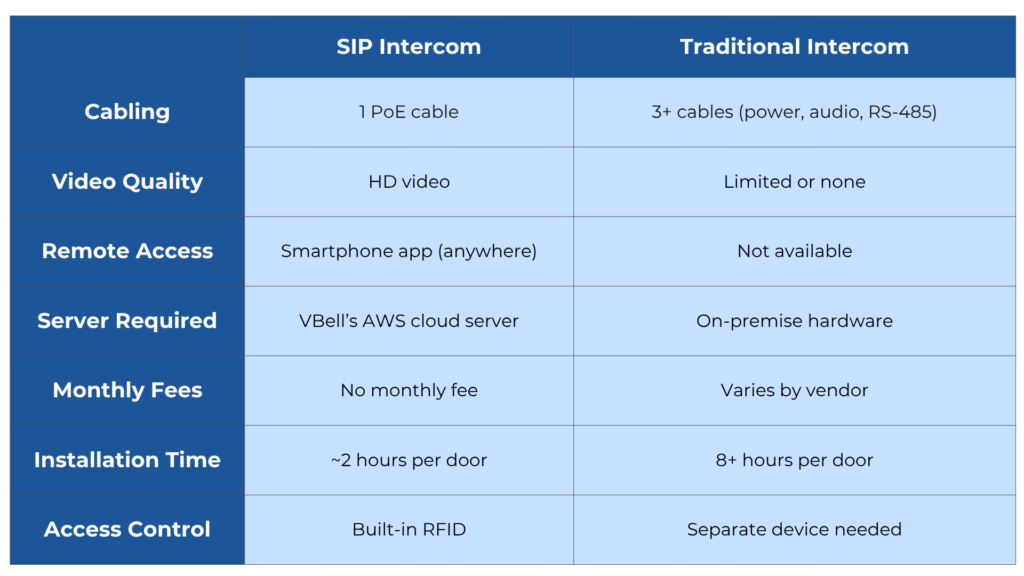
4. Benefits of SIP Intercoms for Buildings and Homes
The advantages of SIP-based intercom systems extend across every vertical — from commercial towers to single-family homes.
For Commercial Buildings
- Unified visitor management — Route calls to reception, security, or directly to individual offices based on time-of-day rules and directory lookups.
- Employee access control — Replace standalone badge readers with a single device that handles RFID, QR code, and Face recognition.
- Remote monitoring — Security teams can view live video feeds and unlock doors from any location via a smartphone or desktop client.
For Residential Buildings & Apartments
- Smartphone-based door answering — Tenants answer visitor calls on their mobile phone, eliminating the need for expensive indoor monitors in every unit.
- No monthly subscription — A VBell APP no monthly fee model means predictable costs for property managers and HOAs.
- Modern tenant experience — Today’s renters expect app-based building access. SIP intercoms deliver that experience without a six-figure platform investment.
For Healthcare Facilities
- Nurse call integration — SIP intercoms can tie into existing nurse call and paging systems, providing visual verification at secure entry points.
- Patient and staff safety — Controlled access to wards, pharmacies, and restricted areas with full audit trails.
For System Integrators
- Faster installations — One cable per door means fewer labor hours and simpler project planning.
- Higher margins — Reduced material and labor costs translate to better profitability on every project.
- Fewer callbacks — IP-based systems are easier to diagnose and update remotely, reducing post-installation service visits.
The versatility of SIP technology makes it the ideal foundation for any apartment intercom solution or commercial door access control system — and no device demonstrates that versatility better than the DP-104.
5. Introducing the VBELL DP-104 — The Ultimate SIP Door Station
The VBELL DP-104, designed and manufactured by AvaDesign Technology in Taiwan, is purpose-built for system integrators who need a reliable, feature-rich SIP door station that installs in a fraction of the time of traditional solutions.
A True 2-in-1 Solution
The DP-104 combines a full-featured SIP video intercom with integrated access control in a single device — eliminating the need to source, install, and configure separate intercom and reader units.
Key Features
- HD Video via AWS cloud server — Crystal-clear video calls routed to any smartphone, anywhere in the world. No proprietary app ecosystem required.
- IP Access Control — RFID card, QR code, and Facial recognition entry built into one device.
- PoE Powered (IEEE 802.3af) — One Ethernet cable delivers power, data, and communication. No separate power supply needed.
- Universal PBX Compatibility — Works seamlessly with FreePBX, Asterisk, 3CX, and any standards-compliant SIP platform.
- No Monthly Fees — No cloud subscription required for basic operation. The device works out of the box with your existing SIP infrastructure.
- Made in Taiwan — Designed and manufactured with a reliable, traceable supply chain. Full engineering support from AvaDesign’s R&D team.
6. Frequently Asked Questions
Q1. What is a SIP intercom and how does it work?
A SIP intercom is a door communication device that uses the Session Initiation Protocol (SIP) to place voice and video calls over an IP network. When a visitor presses the call button, the device initiates a SIP call that routes through a cloud service or local PBX to the tenant’s smartphone, IP phone, or indoor monitor — enabling two-way communication and remote door unlocking.
Q2. Do I need a SIP server to use the DP-104?
Not necessarily. The DP-104 supports AWS cloud server, which eliminates the need for any on-site server hardware. Simply connect the device to your network, register it with our APP – VBell, and it’s ready to go. For organizations with existing PBX infrastructure, the DP-104 also integrates with on-premise systems like FreePBX, Asterisk, and 3CX.
Q3. Can the DP-104 work with my existing PBX?
Yes. The DP-104 is built on open SIP standards and is fully compatible with FreePBX, Asterisk, 3CX, and virtually any standards-compliant SIP server or hosted VoIP platform.
Q4. Is there a monthly fee for using the DP-104?
No. The VBELL requires no monthly subscription for its core intercom features. You own the device and the functionality outright. Optional cloud VoIP services may carry their own service fees depending on the provider you choose, but the standard APP VBell itself has no recurring charges.
Q5. What types of buildings is the DP-104 suitable for?
The DP-104 is designed for a wide range of applications, including apartment buildings, commercial offices, healthcare facilities, gated communities, co-working spaces, and single-family homes.
Conclusion: The Future of Building Access Starts with SIP
SIP intercom systems represent the future of building communication — replacing outdated analog wiring with flexible, scalable, IP-based technology that tenants and building managers actually want to use.
The VBELL DP-104 by AvaDesign Technology is engineered specifically for system integrators who want to maximize installation efficiency, reduce material costs, and deliver a premium tenant experience — all without locking their clients into expensive subscriptions or proprietary platforms.
Whether you’re outfitting a 200-unit apartment complex or a single commercial entrance, the DP-104 gives you HD video, multi-mode access control, and universal SIP compatibility in one weatherproof, PoE-powered device.